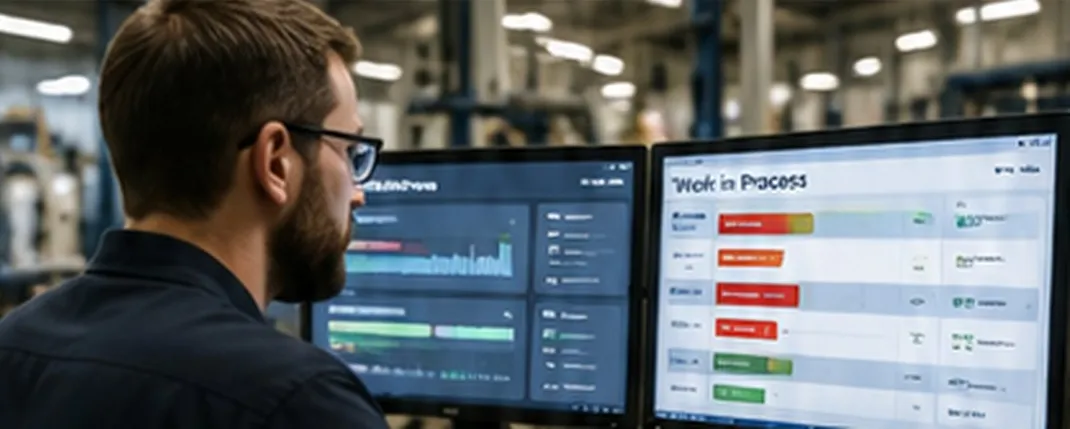
See WIP as it moves
Track jobs, queues, completed operations and handoffs instead of waiting for a spreadsheet update.
Industrial Automation / MES Integration
Connect what is happening on the production floor to the systems that schedule work, manage inventory, track costs and run your business. See the WIP, find the bottlenecks and get more finished product out the door.
Quick Answer — What is MES integration?
MES (manufacturing execution system) integration connects production execution—work orders, WIP, machine events, labor, quality and completion records—with PLCs, SCADA, ERP, databases and other business systems. The objective is to make actual production information available where it is needed without forcing manufacturers to replace systems that already work.
Why MES Integration Matters
A job can be released, materials purchased and a delivery date promised while the actual work waits between machines, departments or approvals. MES and manufacturing operations software close that visibility gap by connecting work in process to the people and systems responsible for moving it forward.
Track jobs, queues, completed operations and handoffs instead of waiting for a spreadsheet update.
Compare work orders and schedules with machine, operator and production events.
See where material, labor and equipment are waiting so capacity improvements start with evidence.
Move approved production results to inventory, costing, ERP and reporting workflows.
Connect inspections, rejects, rework and completion records to the right job or lot.
Use better execution visibility to remove avoidable delays and improve throughput.
Shop Floor to Enterprise
PLCs control equipment. SCADA monitors processes. MES tracks production execution. ERP manages business transactions. Ayoka connects the layers around the work—not the other way around.
Each connection should define the system of record, data ownership, validation, timing, permissions and recovery when a system is unavailable.
What MES Makes Visible
Work in process is where material, labor and overhead are committed but the finished product has not shipped or been invoiced. When you can see where jobs are moving, waiting, being reworked or getting stuck, you can find the constraint that is tying up capacity and cash.
Useful views may include work-order status, operation queues, labor capture, cycle time, downtime, scrap, quality checks and completed quantities. The right data depends on the actual production process.
Talk About Your WIP Visibility →
What Ayoka Connects
MES integration is not a mandate to replace ERP or buy an entirely new platform. It is the work of connecting the production events and workflows that matter.
Capture approved counts, cycle completion, run states or downtime events from equipment.
Use selected process history, alarms or events to provide production context.
Send validated completion, consumption, scrap or labor information into business records.
Coordinate release, status, material availability and production priorities.
Connect inspection results, rework, genealogy and operational dashboards.
MES and ERP
Not necessarily. ERP may already handle purchasing, inventory, sales orders and accounting well. MES or a focused manufacturing operations layer becomes useful when you need better execution visibility: which job is running, what operation is complete, where WIP is waiting and what should be recorded back to ERP.
Ayoka starts by mapping the gap. Sometimes the answer is MES integration. Sometimes it is a targeted workflow, a dashboard or a connection between systems you already own.
Start With the Process, Not a Product
A sophisticated manufacturing execution system will not fix an unclear handoff or an inaccurate work-order process by itself. Ayoka examines where work and information actually stall, then connects or builds what the operation needs.
Map the order-to-shipment workflow and locate delays, re-entry, queues and missing visibility.
Use the existing ERP, PLCs, SCADA, spreadsheets and operational applications where practical.
Add the right MES integration, B.O.S.S. workflow, dashboard or purpose-built software.
Legacy Systems and Technical Integration
Useful manufacturing equipment and established business software do not automatically need replacement. Integration may involve PLC data, OPC / OPC UA, Modbus, EtherNet/IP, PROFINET, SQL databases, APIs and approved middleware where supported by the installed environment.
Ayoka's work also considers read-only versus read/write boundaries, network segmentation, access permissions, data validation, audit trails and recovery.
The Third Way
Ayoka’s Rent Custom Software approach gives you MES capabilities configured for your operation at a fraction of the cost of traditional solutions. You get a system that fits your workflow, without the long timelines and high upfront costs.
Manufacturing Experience
Ayoka's experience spans industrial equipment, PLC integration, production data, databases, dashboards and business workflows. The focus is the same across projects: connect the operation around the constraint and improve how work moves.
Explore Ayoka's work connecting production workflows and operational information.
Sexing Technologies case study →See how software supports coordination and planning in time-sensitive operations.
Refinery turnaround case study →See how PLC and SCADA information can be connected to the broader business.
PLC Integration →How This Applies to Your Operation
Related Manufacturing Solutions
MES is one part of the industrial automation picture. Explore the related services and options that connect machines, production and business systems.
Start the Conversation
Tell us what you're seeing: delayed jobs, unclear WIP, manual production reporting, disconnected ERP data or another operational constraint. We'll start with the process.
Tell us what you’re seeing. We’ll start with the operational problem and help determine what is getting in the way.