Ayoka Systems | Manufacturing Revenue & Constraint Removal
Production Process Improvement • Top-Line Revenue • Scalability • Profitability

How Much Scalability & Profitability is Trapped in Your Production Process?

You may already have the customers, equipment and people to grow. The constraint may be the process itself. Ayoka helps manufacturers find and remove the bottlenecks that limit throughput so they can produce more, ship more, and invoice more. Increase scalability and profitability.

Workflow-first In-plant diagnostics Made in USA Ayoka Systems • Arlington, Texas
The Revenue Chain

An order is not revenue until it moves through the entire operation.

A constraint anywhere between customer demand and invoicing can limit the revenue capacity of the whole system.

Customer Demand
Order
Production
CONSTRAINT
Quality
Shipping
Invoice → Revenue
Production Process Improvement

We don't start with software. We start with the process.

Ayoka maps how work actually moves, identifies what is constraining flow, quantifies the business impact, designs the future state, and only then determines whether automation, integration, AI, dashboards, portals, B.O.S.S. or custom software should be used.

1

Map the real workflow

Follow the order end-to-end, not the process manual.

2

Find the constraint

Locate waiting, re-keying, disconnected systems, bottlenecks and invisible work.

3

Quantify the impact

Turn operational friction into hours, dollars, capacity and revenue opportunity.

4

Remove it

Fix the highest-value constraint first, then measure the improvement.

The C4 Audit

Find the constraint across the complete order-to-revenue system.

The C4 Operational Audit is Ayoka's diagnostic for answering one question: have you ever analyzed and quantified what your production constraints are costing you? We examine Connections, Constraints, Costs and Capacity before anyone recommends a technology project.

C1

Connections

Where ERP, CRM, spreadsheets, QuickBooks, shipping tools, paper and people do, or do not talk to each other.

C2

Constraints

The bottlenecks, gaps, turnaround delays, re-keying and manual work that slow the job from order to invoice.

C3

Costs

Quantify the labor, errors, rework, missed charges, scrap, delays and other financial drag created by those constraints.

C4

Capacity

Determine what more the same people, equipment and facilities could produce if the constraint were removed.

Request a C4 Audit

What You Get

Not another assessment. A quantified picture of where the money is.

The C4 Audit is designed to turn familiar frustrations into numbers a leadership team can act on. The output shows where people are filling the gaps between systems, what those handoffs cost, and which fixes offer the fastest path to more capacity.

Connections mapped

See the real systems, spreadsheets, paper and tribal knowledge touching an order.

Constraints quantified

Translate minutes, touches, delays and re-keying into annual operational drag.

Costs ranked

Separate the biggest number from the fastest-payback opportunity.

Capacity exposed

Show where better flow could let the same operation take, produce and ship more work.

Sample C4 Output

A result leadership can understand in one screen.

Example manufacturing audit: 12 handoffs traced, 10 re-key points, 8,108 manual hours/year, and a $298,695 defensible annual floor after a 30% confidence haircut.

Then we rank the top three opportunities by impact versus effort, so the conversation becomes what should we fix first?, not what software should we buy?

DEFENSIBLE ANNUAL FLOOR
$298,695
FRAGMENTATION
84 / 100 — Severe
90-DAY SHORTLIST
Start with the fastest-payback constraints
How We Do It

You may be paying people to be your integration layer.

The C4 Audit follows one real order from the customer's PO to the invoice and counts every place information crosses between systems, people, spreadsheets, paper and tribal knowledge.

90 minutes in your plant.
No data request, no system access and no homework in advance.
Count the handoffs.
Connected, bridged or manual, especially where the same information is re-keyed.
Put a number on the drag.
Manual hours, labor cost, error exposure and a deliberately discounted defensible floor.
Rank what to fix first.
Prioritize by impact versus effort instead of simply chasing the biggest number.
BRIDGED
Salesforce quote → person re-keys → ERP sales order
MANUAL
Excel schedule → printed traveler → signed paper → re-entry
MANUAL
Hand-written QC → Word certificate → customer
CONNECTED
Shipment → automatic invoice

“The problem isn't just your software. It's what happens in between.”

Interactive Calculator

Have you ever quantified what your production constraints are costing you?

Use rough numbers. This is a screening estimate, not the C4 Audit. The purpose is to determine whether the opportunity is large enough to investigate with your actual process.

Ayoka Constraint + Handoff Calculator

What could the constraint be worth?

Change any assumption. Results update instantly.

We discount the finding before you do.
Orders you could potentially serve if capacity improves.
Conservative share of constrained demand potentially recovered.
Manual hours / year
Gross annual drag
Defensible annual floor
Potential added top-line revenue
Illustrative screening estimate only. Manual labor drag and error exposure follow the C4 Audit logic. Potential added revenue is calculated from your entered order volume, average revenue/order, unfulfilled or delayed demand and recoverable-constraint assumption. It is not a guarantee of revenue. The C4 Audit replaces assumptions with your actual workflow and operating data.
What Changes

Remove the constraint. Increase throughput. Increase top-line revenue.

Produce more

Recover capacity hidden inside waiting, re-keying and coordination failures.

Ship sooner

Reduce queue time between production, quality, inventory and fulfillment.

Invoice faster

Connect completion and shipment to the systems that turn work into cash.

Scale intelligently

Increase volume before automatically adding people, equipment or another disconnected system.

Frequently Asked Questions

What is a production constraint in manufacturing?

A production constraint is anything that limits the amount of customer demand a manufacturer can successfully convert into completed, shipped, and invoiced orders.

A constraint can be physical, such as equipment capacity or material availability. It can also be operational or informational: disconnected systems, manual data entry, spreadsheets, approval delays, scheduling problems, quality processes, poor production visibility, or employees having to move information manually between systems.

Ayoka Systems looks beyond individual machines to examine the entire order-to-revenue process. The objective is to identify which constraints are actually limiting throughput, capacity, and top-line revenue.

How can production constraints reduce top-line revenue?

A manufacturer can have customer demand and still be unable to convert all of that demand into revenue.

An order must move through multiple stages before it can be invoiced:

Customer Demand → Order → Planning → Production → Quality → Shipping → Invoice → Revenue

If a constraint slows any critical stage, it can limit the throughput of the entire process.

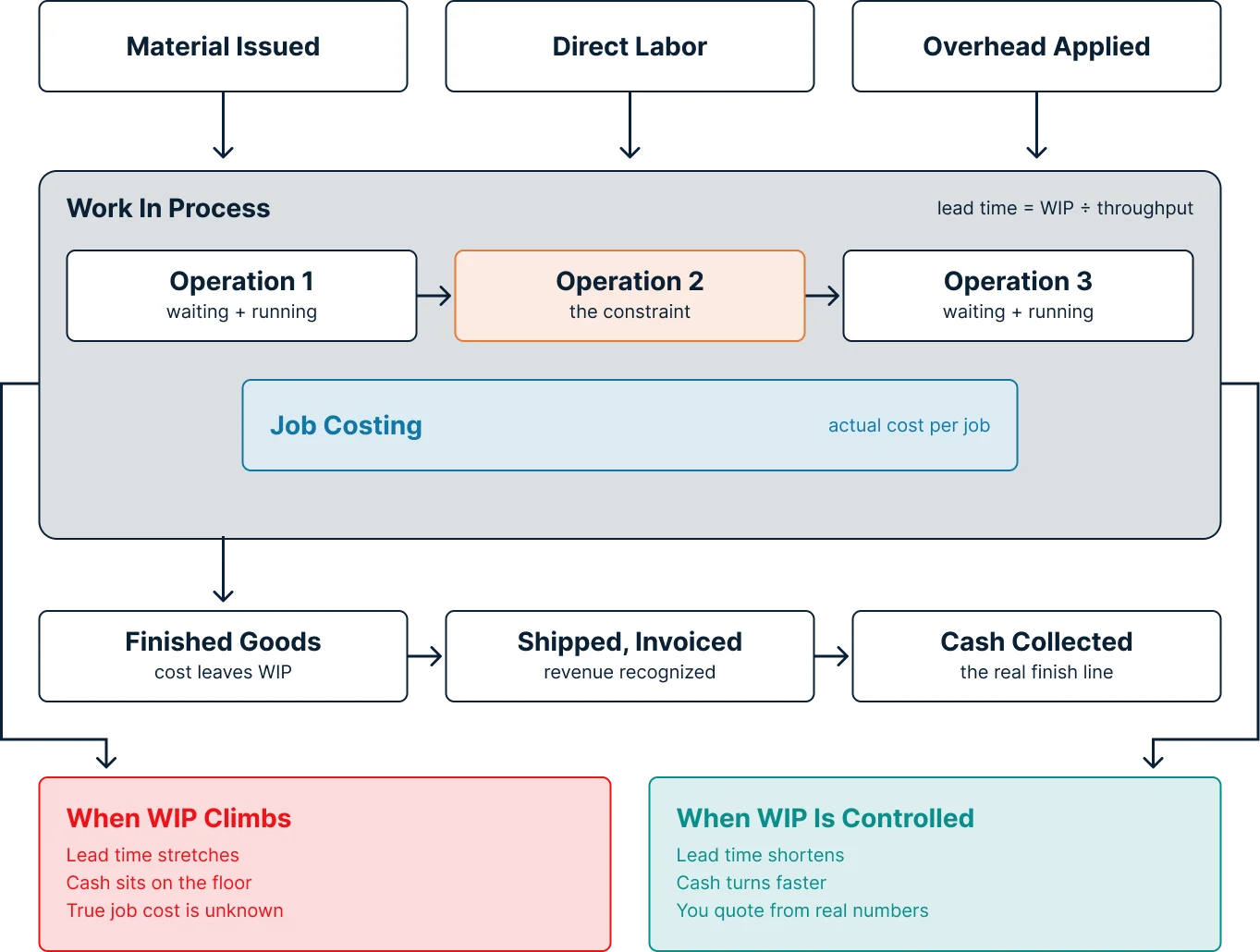
The business impact may appear as longer lead times, orders that cannot be accepted, delayed shipments, delayed invoices, excessive work in process, overtime, additional headcount, missed charges, or production capacity that management cannot confidently sell.

That is why Ayoka evaluates production improvement in terms of business capacity and top-line revenue, not efficiency alone.

Have you ever quantified what your production constraints are costing you?

Many manufacturers know they have manual processes, disconnected systems, bottlenecks, and workarounds. Far fewer have quantified their financial impact.

Ayoka's approach is to convert operational friction into measurable numbers.

For example:

  • How frequently does the activity occur?
  • How many people touch it?
  • How much time does each occurrence consume?
  • How often is information re-entered?
  • What happens when an error occurs?
  • Does the constraint delay production or shipment?
  • Could eliminating it allow the company to process more orders with its existing people and equipment?

Once those questions are quantified, a vague operational frustration can become a measurable business case.

What is Ayoka's C-4 Audit?

The Ayoka C-4 Audit is a manufacturing-focused operational analysis built around four areas:

Connections. Constraints. Costs. Capacity.

Connections: Where do systems, people, departments, machines, spreadsheets, paper processes, and information need to interact?

Constraints: Where does work wait, stop, require intervention, or depend on a manual workaround?

Costs: What are those constraints costing in labor, errors, rework, delays, missed charges, and other measurable impacts?

Capacity: If the constraint were removed, how much additional work could the existing operation potentially handle?

The purpose is not to begin by recommending software. The purpose is to identify and quantify what is preventing the business from performing at a higher level.

What is the difference between a C-4 Audit and a software audit?

A software audit usually starts with applications.

A C-4 Audit starts with the business and production process.

Ayoka examines how work actually moves through the organization and where connections, constraints, costs, and capacity affect business performance.

Existing software may ultimately be part of the solution. In other situations, the answer may involve improving a workflow, connecting existing applications, eliminating redundant work, automating a manual process, improving visibility, or changing how information moves.

Ayoka does not assume that buying another application is the answer.

What are disconnected systems in manufacturing?

Disconnected systems are applications, spreadsheets, databases, machines, paper processes, or other sources of information that need to exchange data but cannot do so effectively without human intervention.

A manufacturer might use an ERP for orders, Excel for scheduling, a separate quality system, another application for shipping, a CRM for sales, and accounting software for financial information.

Each application may work individually.

The problem often exists between them.

When employees copy information, re-key data, export and import spreadsheets, send internal emails, print documents, or manually reconcile information, people become the integration layer between systems.

What is a handoff in a manufacturing process?

A handoff occurs whenever work or information moves from one person, department, system, spreadsheet, document, or process to another.

For example:

  • Customer PO → ERP
  • ERP → Production Schedule
  • Production Schedule → Shop Floor
  • Production → Quality
  • Quality → Shipping
  • Shipping → Invoicing

Handoffs are important because operational problems frequently exist between systems rather than inside them.

Ayoka examines these handoffs to identify where employees are manually moving information, where errors can be introduced, and where work is waiting unnecessarily.

Why does Ayoka focus on handoffs between systems?

Because a list of software applications tells you what a manufacturer owns.

The handoffs tell you how the operation actually works.

Two applications can both be functioning correctly while employees spend hundreds or thousands of hours each year transferring information between them.

That manual work can create labor cost, transcription errors, delays, dependency on specific employees, and constraints on growth.

Finding those hidden handoffs can reveal opportunities that a conventional software inventory misses.

What does it mean when employees are acting as the integration layer?

If an employee has to read information from one system and manually enter the same information into another, that employee is performing work that connected systems could potentially perform automatically.

This can happen when employees:

  • Re-enter customer orders
  • Transfer production schedules
  • Copy inventory information
  • Build quality documentation manually
  • Reconcile spreadsheets with an ERP
  • Move shipping information between applications
  • Re-enter information into accounting software
  • Look information up in one system so they can use it in another

Ayoka refers to these activities as important handoffs because they can consume capacity without directly creating additional product or customer value.

How can disconnected systems limit manufacturing capacity?

Disconnected systems consume employee time.

As order volume increases, manual coordination frequently increases with it. Eventually the number of orders a company can process becomes limited not by customer demand or equipment, but by the ability of employees to coordinate the information surrounding production.

This creates an important growth question:

Can the manufacturer process more orders with the people and equipment it already has?

Removing unnecessary manual handoffs can sometimes increase effective capacity without proportionally increasing administrative headcount.

What does “more with the same” mean in manufacturing?

“More with the same” means increasing the amount of productive work an operation can handle using substantially the same underlying resources.

Instead of immediately adding employees, equipment, shifts, or applications, Ayoka looks for constraints preventing existing capacity from being fully utilized.

If those constraints can be removed, a manufacturer may be able to quote more work, accept more orders, produce more, ship sooner, or invoice faster using resources it already has.

That can create a direct connection between Production Process Improvement and top-line revenue.

How can better production visibility increase revenue?

A manufacturer cannot confidently sell capacity it cannot see.

If management lacks reliable visibility across production lines, plants, work centers, schedules, inventory, or work in process, the organization may decline opportunities or quote conservatively because it cannot confidently determine whether additional work can be delivered.

Improved capacity visibility can therefore do more than improve reporting.

It can influence what the company is willing and able to sell.

What is Production Process Improvement (PPI)?

Production Process Improvement, or PPI, is Ayoka's workflow-first approach to improving manufacturing operations.

The process begins by understanding how work actually moves from customer demand through production and ultimately to revenue.

Ayoka then:

  1. Maps the workflow.
  2. Identifies constraints and manual handoffs.
  3. Quantifies their operational and financial impact.
  4. Prioritizes the highest-value opportunities.
  5. Designs the improved future state.
  6. Determines what technology, if any, is necessary to achieve it.

The technology follows the business case rather than defining it.

Does Production Process Improvement always require new software?

No.

One of the most important conclusions of a proper production-process analysis may be that the manufacturer does not need another software application.

The solution could involve configuring software the company already owns, connecting existing systems, changing a workflow, eliminating redundant steps, automating data movement, improving reporting, or developing a targeted application for a specific operational gap.

Ayoka's objective is to remove the constraint—not to sell a predetermined technology.

How do you calculate the cost of manual processes in manufacturing?

The calculation depends on the process, but a useful starting point is:

Occurrences × Time per Occurrence × Loaded Labor Rate

For example, if an activity occurs 100 times each week, consumes six minutes each time, operates 50 weeks per year, and uses labor costing $45 per hour, the annual labor impact can be calculated.

A more complete analysis can also consider:

  • Re-keying error rates
  • Rework
  • Scrap
  • Expedited shipping
  • Credit memos
  • Missed charges
  • Delayed invoices
  • Downtime
  • Lost throughput
  • Additional administrative headcount
  • Orders the company cannot accept

The most important inputs should come from the manufacturer's own operation rather than relying entirely on generic industry benchmarks.

What is the difference between cost savings and top-line revenue growth?

Cost savings improve the economics of producing the current level of business.

Top-line revenue growth increases the amount of business the company can sell, produce, ship, and invoice.

Ayoka distinguishes between the two.

Saving administrative labor has value. But if removing the same constraint also allows the manufacturer to process additional orders, the larger opportunity may be increased revenue capacity.

That is why Ayoka asks not only:

“What does this problem cost?”

but also:

“What could you produce and sell if this constraint disappeared?”

How can faster invoicing affect a manufacturer?

Production is not the end of the revenue process.

If completed work waits before shipment or completed shipments wait before invoicing, operational delays can affect cash conversion and financial visibility.

Ayoka examines the complete order-to-revenue workflow because production, quality, shipping, and invoicing are interconnected.

The goal is to reduce unnecessary time between customer demand and realized business value.

Can manual processes cause manufacturers to miss revenue?

Yes.

Manual processes can contribute to missed or delayed charges when information required for billing is incomplete, unavailable, or dependent on an employee remembering to capture it.

Examples can include special services, change orders, expedited work, storage, accessorial charges, additional processing, or other billable activities.

The specific opportunities vary by manufacturer, which is why Ayoka maps the actual workflow rather than assuming where revenue leakage occurs.

Should a manufacturer replace its ERP if employees still use spreadsheets?

Not necessarily.

The existence of spreadsheets does not automatically mean the ERP should be replaced.

The more useful questions are:

  • Why is the spreadsheet necessary?
  • What information does it contain that the ERP does not?
  • Who maintains it?
  • What happens if it is wrong?
  • Does information have to be manually transferred between the spreadsheet and another system?
  • Can the existing ERP be configured or integrated to eliminate the gap?

Replacing an ERP can be expensive and disruptive. Ayoka first determines whether the constraint can be removed using systems the manufacturer already owns.

What is Multiple Application Disorder?

Multiple Application Disorder (MAD) is Ayoka's term for an operational condition in which a company has accumulated multiple applications that individually perform useful functions but collectively create fragmentation.

The symptom is not simply “too much software.”

The important symptoms are the gaps between applications: duplicate data entry, inconsistent information, spreadsheets, manual reconciliation, workarounds, and employees carrying information from one system to another.

The cure is not automatically another application.

It begins with understanding the workflow and determining which connections actually matter.

What is Software Jail?

“Software Jail” describes the situation in which a business becomes constrained by software rather than enabled by it.

The organization may have significant investments in applications but still depend on spreadsheets, manual workarounds, duplicate entry, expensive customization, or processes designed around what the software permits rather than what the business requires.

Ayoka's objective is not necessarily to replace those systems. It is to help the business regain control of its workflow and use technology in service of the operation.

What kinds of manufacturing problems can Ayoka help investigate?

Ayoka is particularly interested in problems involving:

  • Production scheduling
  • Disconnected systems
  • Manual data entry
  • Production visibility
  • Capacity visibility
  • Job costing
  • Inventory information
  • Quality processes
  • Traceability
  • Production reporting
  • Shipping and fulfillment
  • Order-to-invoice delays
  • Missed billable charges
  • Spreadsheet-dependent workflows
  • System integrations
  • Rework caused by information errors
  • Processes that require additional headcount as volume grows

These are examples, not a predetermined checklist. The actual constraint must be determined from the manufacturer's operation.

Does Ayoka start by recommending AI or automation?

No.

Ayoka starts with the production process.

AI, automation, integration, dashboards, custom applications, existing software configuration, and other technologies are tools.

The question comes first:

What constraint are we trying to remove, and what measurable business result will removing it create?

If AI is the appropriate tool, Ayoka can use it. If a simple integration solves the problem more effectively, the integration may be the better answer.

Why does Ayoka walk the manufacturing floor?

Because the process described in a conference room and the process occurring on the plant floor are not always the same.

A floor walk can reveal paper travelers, handwritten quality records, whiteboard schedules, printed documents, spreadsheets, laptops used for re-entry, disconnected workstations, and other operational handoffs that may never appear on an architecture diagram.

Ayoka believes understanding the physical production process is essential to understanding the information process surrounding it.

Who should be involved in a manufacturing process analysis?

The strongest analysis usually includes people who understand both how the process was designed and how it actually operates.

That can include:

  • Operations or plant leadership
  • Production scheduling
  • ERP or business-system ownership
  • Quality
  • Shipping or fulfillment
  • Finance when appropriate
  • Employees who actually perform the manual work

Frontline operational knowledge is particularly valuable because workarounds often become invisible to management over time.

What information does Ayoka need before discussing a manufacturing problem?

A manufacturer does not need a perfect process map or extensive technical documentation simply to begin the conversation.

A useful starting point is often one real business process or order and questions such as:

  • Where does it begin?
  • Where does information go next?
  • Who touches it?
  • What systems are involved?
  • Where does it wait?
  • What gets entered more than once?
  • What happens when something goes wrong?

Those questions can expose a surprising amount about an operation.

What types of manufacturers are a good fit for Ayoka?

Ayoka is particularly relevant to small and mid-market manufacturers whose operations have become more complex as the company has grown.

Common signals include multiple business systems, spreadsheet-dependent workflows, manual production processes, limited capacity visibility, acquisitions that introduced additional systems, older ERP environments, and growth that increasingly requires additional administrative headcount.

The strongest fit is a manufacturer that wants to understand whether its existing operation can support more business before simply adding more cost.

What does Ayoka Systems actually sell?

Ayoka sells the ability to understand and improve complex business and production processes.

Depending on what the analysis reveals, implementation may involve systems integration, workflow automation, dashboards, portals, custom applications, AI, changes to existing software, or other technology.

But those are implementation tools.

The business objective is removing constraints that prevent the organization from performing, scaling, and generating revenue at a higher level.

How is Ayoka different from a traditional software development company?

A traditional software development conversation often begins with:

“What do you want us to build?”

Ayoka prefers to begin with:

“What business constraint are we trying to remove?”

That changes the conversation from software features to business outcomes.

Ayoka maps the workflow, quantifies the problem, designs the future state, and then determines what technology should be built, integrated, automated, configured, or eliminated.

How is Ayoka different from an ERP vendor?

Ayoka does not need to sell a particular ERP.

That allows the company to evaluate whether an existing ERP is actually the problem—or whether the real issue exists in the connections and workflows around it.

Sometimes the right answer is to improve what the manufacturer already owns.

Sometimes integration is required.

Sometimes a specialized application fills a genuine operational gap.

And sometimes larger change is justified.

The diagnosis comes before the prescription.

How does Ayoka connect operational improvement to ROI?

Ayoka attempts to quantify operational problems using the manufacturer's own numbers.

That can include:

Labor consumed + errors + rework + operational delay + missed revenue + constrained capacity.

The resulting opportunities can then be compared against the cost and effort required to address them.

The objective is to prioritize changes based on measurable business impact rather than implementing technology simply because it is available.

What should a manufacturer fix first?

Not necessarily the biggest problem.

The best first project is often the constraint with the strongest combination of:

Business impact + feasibility + speed to value.

A smaller constraint that can be eliminated quickly and produces a measurable return may deserve priority over a much larger transformation requiring years of effort.

Ayoka uses this impact-versus-effort thinking to help manufacturers determine where to start.

Can Ayoka help a manufacturer grow without adding headcount?

Potentially, yes.

The important question is whether current employees are spending significant capacity on work that does not need human judgment.

If employees spend substantial time transferring information, reconciling systems, building reports, re-entering data, chasing approvals, or compensating for disconnected processes, removing those activities may create capacity.

That can allow the same team to handle more volume.

Ayoka describes this objective as:

More with the same.

What is the ultimate goal of manufacturing process improvement?

For Ayoka, the ultimate goal is not simply fewer clicks, fewer spreadsheets, or newer software.

It is a stronger operation.

That can mean:

  • More capacity.
  • More throughput.
  • Faster fulfillment.
  • Better visibility.
  • Fewer errors.
  • Less unnecessary manual work.
  • More orders shipped.
  • More revenue invoiced.

And when customer demand exists:

Removing the right production constraint can become a top-line revenue strategy.

The Question Ayoka Wants Every Manufacturer to Ask

Have you ever quantified what your production constraints are costing you?

If the answer is no, start there.

Connections. Constraints. Costs. Capacity.

The Ayoka C-4 Audit.

Your Next Revenue Increase May Already Be Inside Your Factory

Find the constraint before you add the cost.

Start with a conversation about your order-to-revenue flow. We will determine whether the C4 Audit or a focused production-process review is the right next step.

Captcha