Manufacturing, AI and business developments — November 6, 2026. Images are editorial illustrations or archival photographs, not depictions of the specific reported facilities unless stated.
1. AI chip boom makes advanced packaging a manufacturing bottleneck
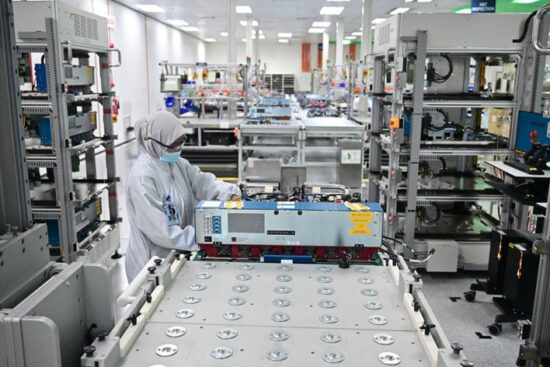
Reuters reported November 6 that AI-chip demand is accelerating investment in advanced packaging, which integrates processors and memory. Industry research forecasts packaging investment near $28 billion in 2026. Suppliers are expanding chip-on-wafer-on-substrate capacity and exploring panel-level packaging; some proposed capacity will not enter production until 2028.
Why It Matters.
AI hardware supply depends on packaging throughput and yields, not just wafer fabrication. Packaging constraints can delay finished accelerators even when chips and memory are available.
Impact on Manufacturing.
Packaging equipment qualification, substrate availability, thermal management, testing and process yield must advance together. Panel-level approaches may improve material utilization, but production scale and reliability still require validation.
Original source: Reuters — November 6, 2026
2. China’s YMTC targets more domestic equipment in planned NAND factory

Reuters reported November 6 that YMTC is aiming for at least 60%, potentially 70%, Chinese-made equipment in its proposed fourth Wuhan NAND fabrication plant. Construction is expected to begin next year, but supplier discussions remain preliminary and no formal orders have been placed.
Why It Matters.
The proposal highlights how export controls and supply-chain concentration are changing semiconductor equipment sourcing and industrial investment.
Impact on Manufacturing.
Domestic tool adoption still depends on qualification, repeatability and compatibility with complex process flows. Cleaning, polishing and etching tools may be easier to localize than advanced lithography and inspection systems.
Original source: Reuters — November 6, 2026
3. Bangladesh garment unrest interrupts more than 100 factories

Reuters reported November 5 that worker protests forced over 100 garment factories in the Ashulia area to suspend operations. Workers are demanding higher minimum wages; a wage-board change is planned, but its size remains unresolved.
Why It Matters.
Bangladesh’s export-oriented apparel sector depends on predictable labor availability and delivery schedules. Prolonged disruption threatens shipment commitments and customer confidence.
Impact on Manufacturing.
Interrupted sewing, cutting, finishing and shipping schedules can create cascading backlogs. Factories and buyers face pressure to replan production, communicate realistic delivery dates and address workforce stability.
Original source: Reuters — November 5, 2026
4. Toyota’s robotics ambitions spotlight factory-scale physical AI

A November 6 Reuters Breakingviews analysis examined Toyota’s plans to commercialize robotics, drawing on its manufacturing capabilities and research. The article cited Toyota’s estimate that its group and suppliers could purchase roughly 400,000 robots by 2040; these are projections, not firm orders.
Why It Matters.
Automakers have deep expertise in repeatable production and deployment, but converting robotics research into a commercially scalable product remains uncertain.
Impact on Manufacturing.
Industrial robot adoption requires safe human-machine interaction, maintenance support, integration with existing lines and reliable performance across varied tasks. Forecast robot demand should not be mistaken for installed productive capacity.
Original source: Reuters — November 6, 2026
5. Box and Nvidia expand enterprise AI search and workflow tools

Reuters reported November 5 that Box expanded its Nvidia partnership with a search product intended to improve AI retrieval from enterprise files and a workflow-building product for AI-driven tasks. The report did not establish plant-specific deployments or quantified productivity results.
Why It Matters.
Manufacturers hold engineering, quality and supplier records across fragmented systems. AI access to documents may improve information retrieval, but the announcement is a software capability rather than evidence of factory performance.
Impact on Manufacturing.
Document-driven processes such as change control and supplier review could benefit from better search and controlled automation. Operational use still requires access permissions, verified data, human approval and integration with production records.