November 12, 2026 | Five reported developments affecting industrial robotics, automotive investment, semiconductor packaging, infrastructure equipment and manufacturing automation. Photographs are illustrative archival images and do not depict the named announcements or facilities.
1. Agile Robots raises $500 million to expand industrial robot production

Illustrative archival photograph, not the named facility or announcement.
German robotics manufacturer Agile Robots raised $500 million in a SoftBank-led financing round that values it at $8.5 billion. Nvidia and Hitachi participated. The company plans more US expansion and production capacity, building on a German plant it says can manufacture up to 10,000 wheeled and legged humanoid robots annually.
Why It Matters.
Investment is moving from laboratory prototypes toward industrial-scale robot production, although announced factory capacity is not the same as delivered robots or proven adoption.
Impact on Manufacturing.
Manufacturers considering humanoid automation will need to test task reliability, safety, integration with existing lines, serviceability and total cost per productive hour before scaling deployment.
Original news source: Reuters, November 12, 2026
2. Kia and suppliers plan $2 billion second vehicle factory in India

Illustrative archival photograph, not the named facility or announcement.
Kia and suppliers announced plans for approximately $2 billion in a second Andhra Pradesh automotive plant, under a memorandum of understanding with the state. The 465-acre facility is intended to add 200,000 vehicles of annual capacity, with production expected in early 2030 and around 12,000 direct and indirect jobs.
Why It Matters.
The project reflects automakers’ long-term commitment to India’s domestic and export markets, while the 2030 start date shows the distance between an investment announcement and operating capacity.
Impact on Manufacturing.
Component suppliers will need to align tooling, localized sourcing, workforce training, quality approval and logistics with a multi-year ramp. Flexible lines for combustion and electric powertrains add scheduling and material complexity.
Original news source: Reuters, November 12, 2026
3. Samsung accelerates high-bandwidth memory packaging line in South Korea

Illustrative archival photograph, not the named facility or announcement.
At a groundbreaking ceremony, South Korean officials highlighted Samsung’s 6 trillion won high-bandwidth memory packaging investment in Asan, with approximately 40 trillion won in associated advanced-equipment investment expected. Samsung now targets June 2028 for line operations, a year earlier than its original plan.
Why It Matters.
Advanced memory packaging is a critical link in the AI hardware supply chain. Moving the planned startup forward increases pressure on equipment suppliers and cleanroom construction schedules, but production output remains prospective.
Impact on Manufacturing.
Packaging-line throughput will depend on equipment installation, qualification, material availability, yield and testing capacity. Upstream equipment makers may face tighter delivery windows as competing AI projects accelerate.
Original news source: Reuters, November 12, 2026
4. Siemens reports record orders as AI data-center demand doubles
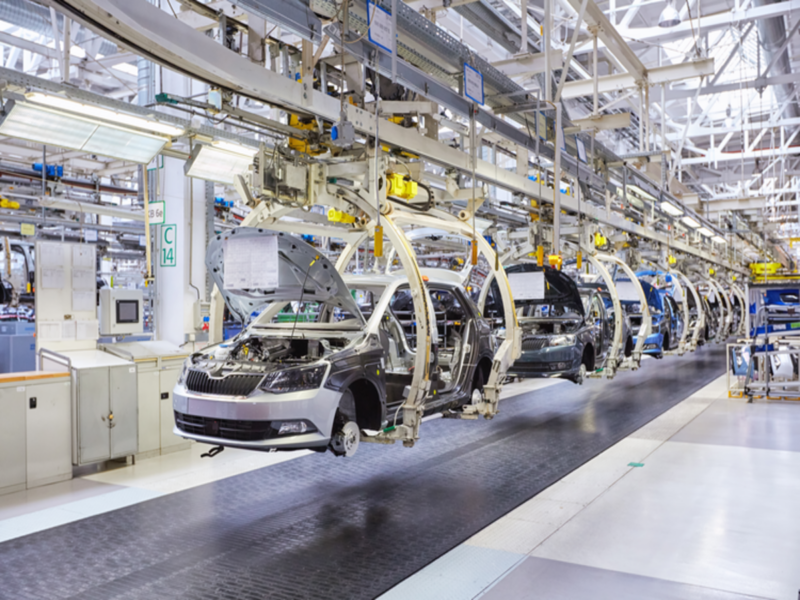
Illustrative archival photograph, not the named facility or announcement.
Siemens reported fourth-quarter industrial profit of €3.89 billion and orders of €34.77 billion, with data-center orders doubling during the quarter. It reported a €143 billion backlog, including €7 billion of data-center products, and raised its mid-term comparable annual revenue growth outlook.
Why It Matters.
Demand for AI infrastructure is translating into orders for industrial electrical and automation equipment, not just computing chips. Backlog growth improves visibility but does not guarantee near-term delivery or cash conversion.
Impact on Manufacturing.
Electrical equipment, controls and infrastructure suppliers must balance expanding order books against component availability, engineering changes and factory throughput. Shipment schedules and acceptance testing determine how quickly backlog becomes recognized revenue.
Original news source: Reuters, November 12, 2026
5. J.P. Morgan projects sharp growth in US humanoid robot manufacturing

Illustrative archival photograph, not the named facility or announcement.
J.P. Morgan forecasts annual US humanoid robot production could reach 300,000 to 400,000 units by 2030 and roughly 1.5 million by 2035, citing labor shortages, improving economics and emerging use cases in manufacturing, warehousing and logistics. These figures are forecasts, not current output or confirmed orders.
Why It Matters.
The projections indicate growing expectations for physical AI, but adoption estimates remain highly sensitive to unit economics, technical maturity and safety acceptance.
Impact on Manufacturing.
Plants should distinguish repeatable task performance from demonstration success. Pilot evaluations need to capture uptime, cycle-time consistency, worker interaction, maintenance demand and actual throughput impact.