01 / OEM manufacturers
Machine and equipment builders
Quote controls, drives, sensors and repeat production requirements using the applicable customer agreement. Support predictable sourcing for their production schedules.
Case study / OEM Electric Supply / Denton, Texas
How OEM Electric Supply retained QuickBooks Desktop and addressed complex pricing and quoting without implementing an ERP.
Give your salespeople the information to quote preferred customers faster, source the right products and protect the margin you expect to earn.
Executive summary
When a machine builder, control panel shop or industrial contractor asks for a price and delivery date, your ability to respond may determine whether that customer awards you the order. Your salespeople need to know the price that applies to that customer, where the product is available, what it will cost to get it there and whether the order can earn the expected margin.
OEM Electric Supply, LLC, based in Denton, Texas, distributes electrical components including motor controls, circuit breakers, relays, sensors and transformers. Its product catalog illustrates the requirements of distributors serving manufacturers and industrial customers. See OEM's product portfolio.
OEM Electric Supply faced a common problem among growing distributors. QuickBooks Desktop continued to serve its accounting needs, but salespeople relied extensively on spreadsheets to manage the pricing rules and calculations necessary to quote customer orders. The price a distributor pays to stock a product is not always the cost it ultimately incurs when selling that product to a particular customer.
OEM pursued an ERP implementation to address its growing operational requirements. As implementation costs increased, confidence diminished in whether the proposed technology and implementation approach could adequately support the business. OEM discontinued the initiative and retained QuickBooks Desktop.
Working with Ayoka Systems, OEM adopted an alternative architecture using B.O.S.S. to support specialized operational requirements while retaining its accounting system. The implementation demonstrates a practical way to separate company-specific quoting and pricing logic from the general ledger, rather than forcing every operational requirement into an ERP.
Win more of the work you want
For independent electrical and industrial distributors, the relationship with a customer is often built on technical product knowledge, reliable sourcing and the ability to respond quickly. The software should make that expertise easier to apply on every quote.
01 / OEM manufacturers
Quote controls, drives, sensors and repeat production requirements using the applicable customer agreement. Support predictable sourcing for their production schedules.
02 / Industrial automation
Respond to project RFQs involving multiple components, availability constraints and expedited freight. Make the cost and margin of individual items visible.
03 / Industrial projects
When a replacement part or project component is needed quickly, compare sourcing options and calculate the cost of meeting the requested delivery date.
These are representative customer segments for electrical distributors, not a list of OEM's confirmed customers.
The business decision
OEM had already invested in an ERP initiative when management reassessed the project. According to the account shared with Ayoka, both the proposed technology and the implementation approach were concerns: implementation costs were escalating, and OEM questioned whether continued investment would deliver the required operational capabilities.
The decision was to stop pursuing that implementation and keep QuickBooks Desktop. This did not eliminate the need to modernize pricing and quoting. OEM still needed a way to manage manufacturer agreements, freight, tariffs and customer-specific acquisition costs without maintaining the logic across spreadsheets.
Move operational rules into a system that can apply them consistently, connect manufacturer information to the quote and transfer the resulting estimate into the accounting system.
QuickBooks Desktop as the accounting platform. The alternative was not a wholesale replacement of OEM’s financial system.
Architecture principle: Standardize the system of record. Customize the system of differentiation. The appropriate boundary depends on what the existing software can do reliably and economically.
Distribution pricing
Electrical distributors may operate under several manufacturer pricing models. A single product can carry different effective costs depending on the customer, the applicable agreement and whether the sale qualifies for a manufacturer credit. B.O.S.S. was designed to bring these distinctions into the quoting workflow.
A distributor has an established purchase price for the product. A separate customer rebate is not required under this model.
The distributor purchases inventory and may subsequently claim a manufacturer credit for an eligible sale to a specified customer. The credit changes the expected economics of that sale.
A manufacturer may negotiate special cost support for products sold to a particular customer over an agreed period or volume. Terms and credit mechanisms vary by agreement.
Consider the same electrical component stocked at $70.00. A distributor targets a 25% gross margin on the effective acquisition cost. The following hypothetical example illustrates how manufacturer rebates change the selling price for eligible customers.
| Per-unit calculation | Customer A | Customer B | Customer C |
|---|---|---|---|
| Original stocking cost | $70.00 | $70.00 | $70.00 |
| Expected manufacturer rebate | $0.00 | $20.00 | $30.00 |
| Effective acquisition cost | $70.00 | $50.00 | $40.00 |
| Target gross margin | 25% | 25% | 25% |
| Suggested selling price | $93.33 | $66.67 | $53.33 |
| Expected gross profit | $23.33 | $16.67 | $13.33 |
Illustrative amounts only; not OEM’s actual costs, customer agreements or results. Excludes freight, tariffs and other expenses. Credits are assumed collectible. Gross margin = (selling price − cost) ÷ selling price.
Customers B and C are quoted below the distributor’s original stocking cost. If the applicable credits are received, the sales still earn the intended margin. If the credits are missed or denied, the expected margin can disappear. Quoting using only the last purchase price can obscure both the opportunity and the risk.
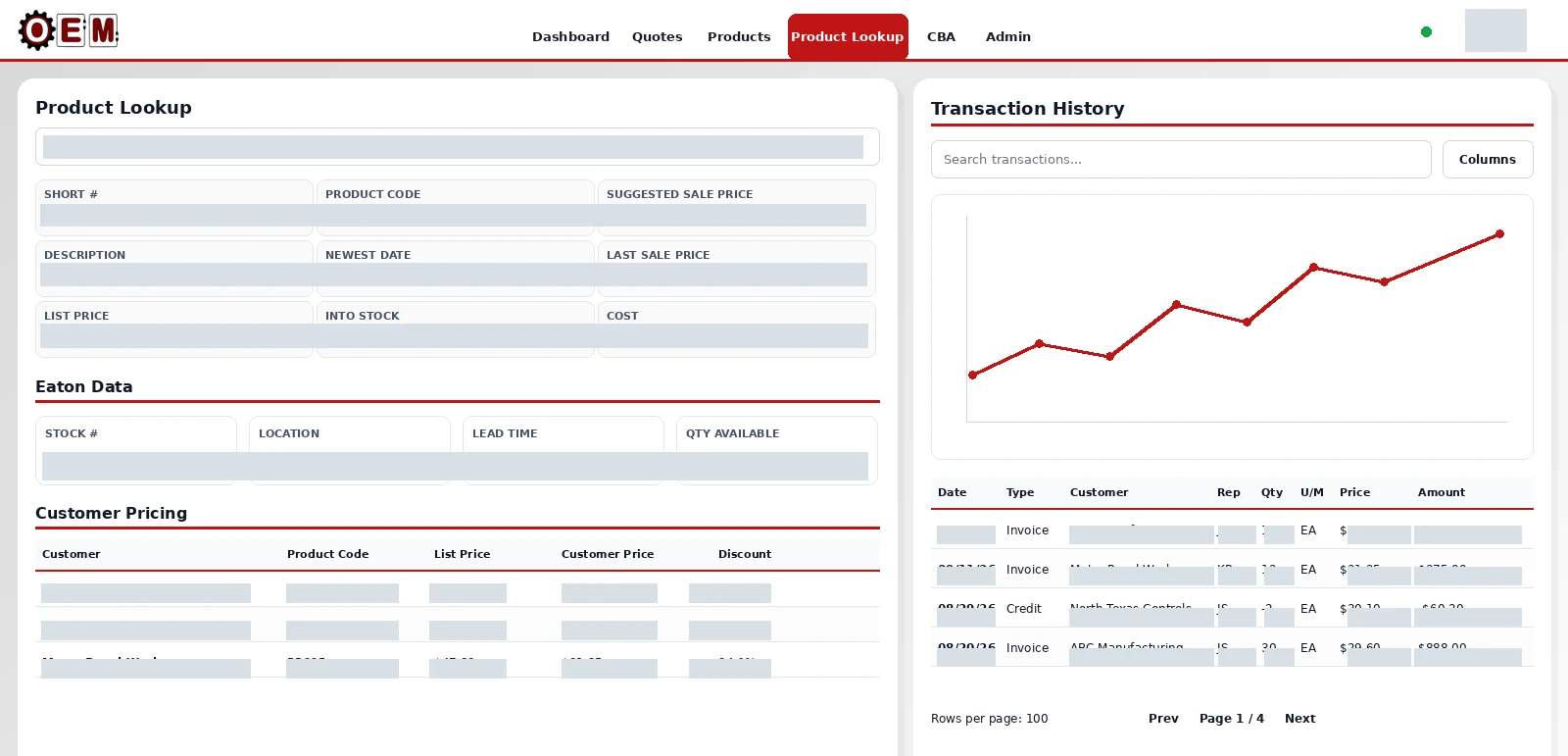
The Product Lookup workspace brings together prior invoice and bill history, customer-based agreements (CBA/CSP), QuickBooks inventory and Eaton pricing and availability. The quote retains the list price, into-stock price and cost used at the time of quoting, along with pricing sources and update timestamps. Salespeople can return to a prior quote and understand the basis for its economics even after catalog prices change.
Quoting & landed cost
A burden is an additional charge or cost associated with an item or transaction. OEM’s quotation logic allows charges to be linked to the product that incurs them, rather than treating all charges as unrelated lines. Manufacturer-level defaults can automatically apply a tariff to applicable products, while quote-specific freight and handling can be added when necessary.
| Cost or charge | Example of how it relates to the quote |
|---|---|
| Tariff | Manufacturer-specific rate applied automatically where applicable, using the configured calculation basis. |
| Freight-in | One item must be sourced from a distant warehouse and shipped to the distributor separately. |
| Freight-out | A product must be repackaged and shipped separately to the customer's job site. |
| Handling / expedite / transaction fee | Additional cost or charge associated with a particular product or transaction. |
| Quote-level freight | Consolidated pallet shipment covering several items, distinct from line-specific freight. |
For example, a quote might contain ten products: nine can ship from the distributor’s warehouse, while the tenth is only available from a manufacturer’s distant location. The additional inbound freight for that item should be reflected in its economics. The quotation may also need to show or suppress a charge or its price, depending on how the distributor presents the offer.
B.O.S.S. supports item-level burden relationships and margin calculations. This enables the quote to reflect how the distributor actually incurs costs, rather than requiring the salesperson to manually associate every additional charge with its underlying product.
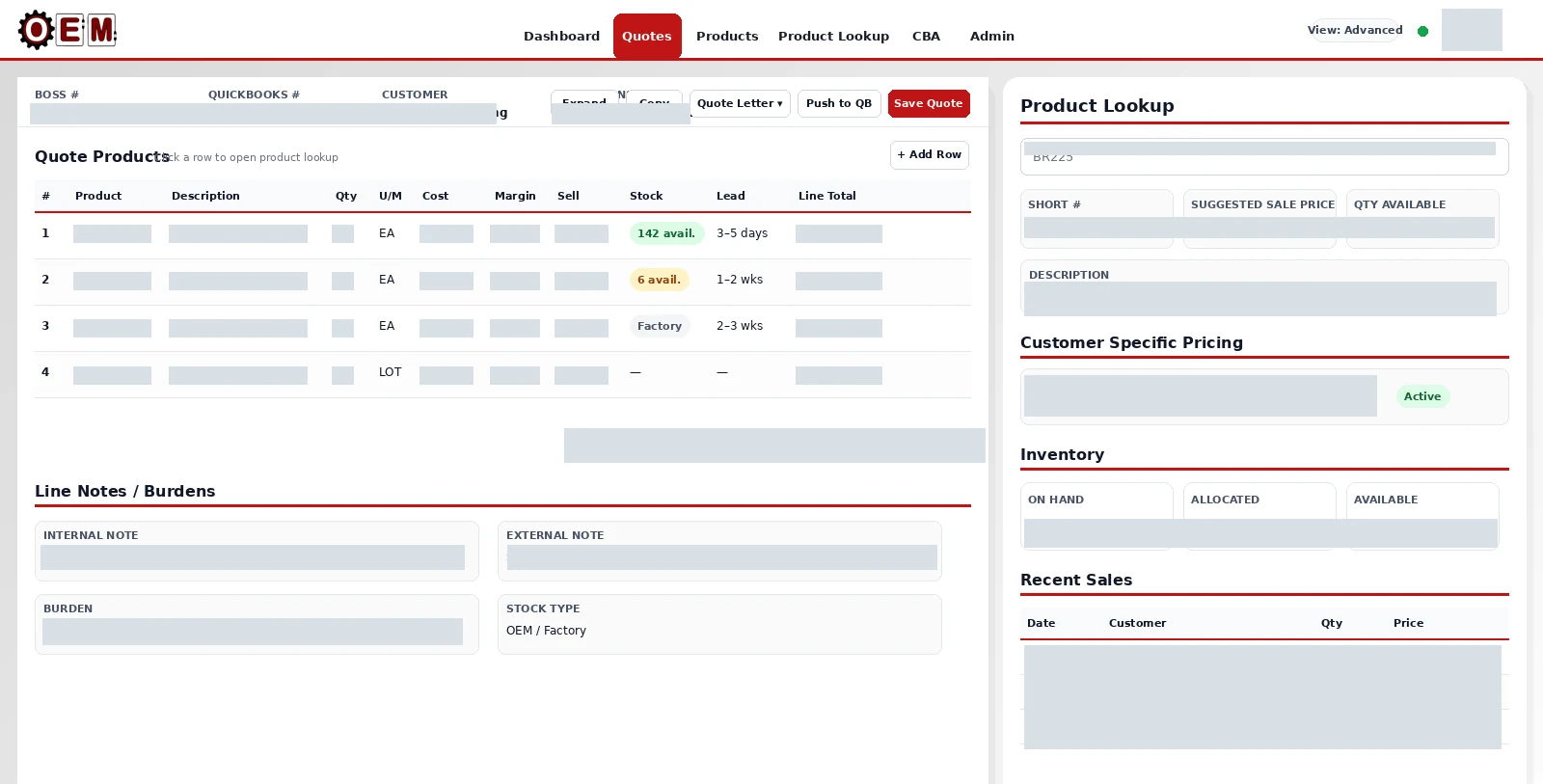
Product-level burdens can be charged to the customer or absorbed by the distributor. Uncharged burdens remain part of internal cost; charged burdens can be shown separately or folded into the parent product on the customer-facing quote letter. Quote-level freight and sales tax are handled separately, including freight that is still to be determined.
Explore how a manufacturer rebate, product-level tariff and freight affect the expected economics of one item.
Supplier integration
OEM’s B.O.S.S. implementation uses Eaton information to inform the quoting process. A salesperson can review supplier pricing and available inventory by location, evaluate sourcing options and associate the additional freight cost with the item when appropriate.
Eaton’s Direct Connect Advantage program provides authorized distributors with APIs for business-specific stocking prices, inventory availability and other product and transaction information. The value of integrating this information is in making it available where salespeople make pricing and delivery decisions.
Learn more about Ayoka’s Eaton Direct Connect integration services.

The quote can distinguish distributor-owned inventory, factory stock and backordered quantities, with lead-time information. A mixed allocation must reconcile to the quantity being quoted. Eaton order inquiry is read-only in the current implementation; automated supplier order submission is not enabled.
Accounting integration
QuickBooks Desktop remains OEM’s accounting system. B.O.S.S. supports the specialized quote calculations and transfers estimates through QuickBooks Web Connector. The integration has been tested with successful estimate transfers; the team has also refined error reporting, retry behavior and handling of product descriptions containing special characters.
This is a practical illustration of the importance of designing integration for day-to-day operations. Data needs to be validated and mapped to the receiving system’s supported formats, and exceptions need to be visible so they can be corrected instead of silently disappearing.
Customer agreements, product pricing, quote burdens and proposed selling prices.
Estimate transfer, validation, retry and error reporting through supported interfaces.
QuickBooks Desktop retains its role in the financial record.
Explore ERP, accounting and job costing integration for related applications of this approach.
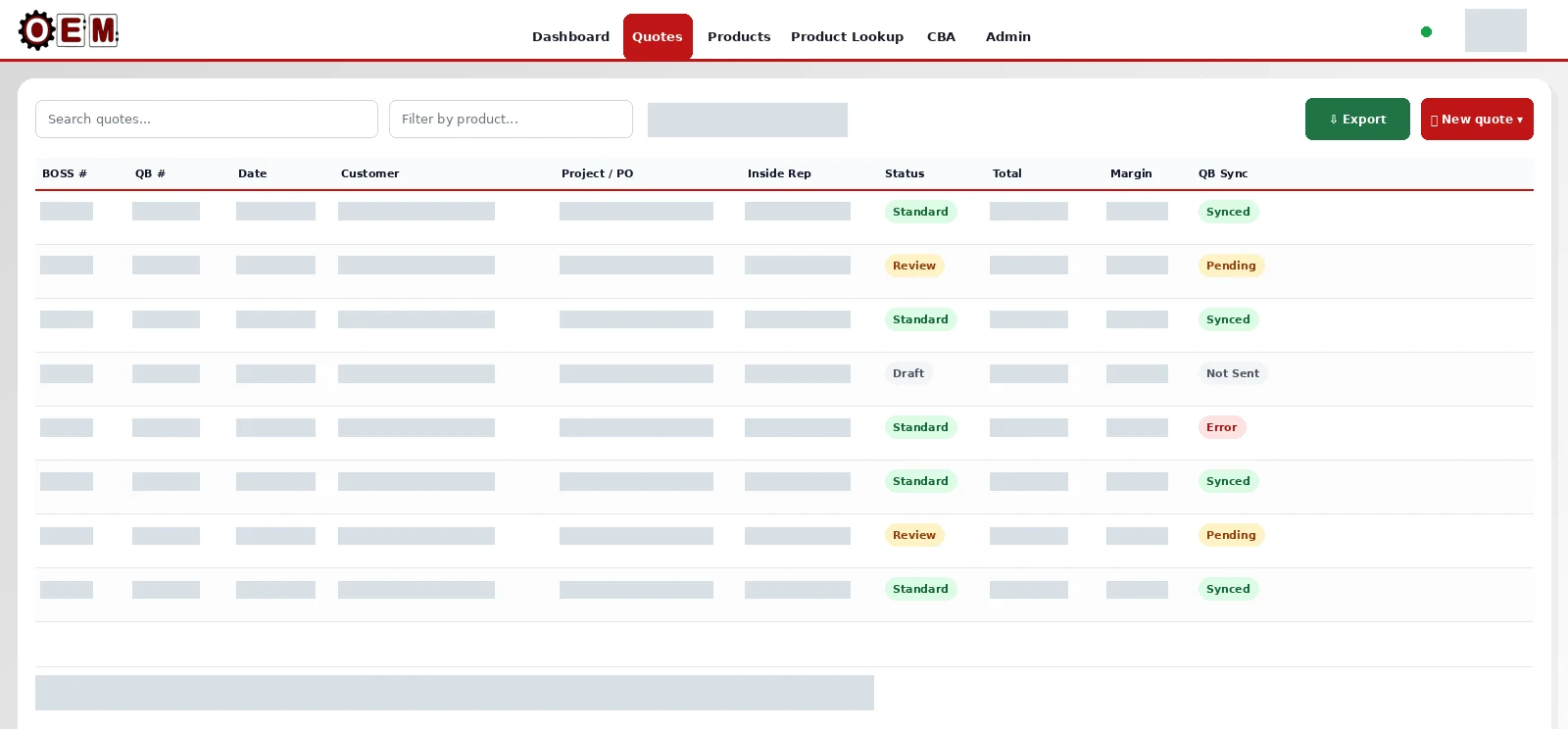
New catalog products that do not yet exist in QuickBooks can be routed for review and approval before an estimate is transferred. The integration also handles approved product creation and ship-to address synchronization as required, while QuickBooks retains control of its destination tax settings.
Margin & working capital
From quote to order
When a saved quote is converted to a B.O.S.S. sales order, the implementation retains the originating quote and its pricing and burden snapshots. It rechecks applicable customer pricing agreements and, where configured, Eaton net prices and available stock. Differences are surfaced as warnings for review. This gives the distributor an opportunity to identify cost changes or supply constraints before proceeding with the order.
Keep the original price, cost and stock context.
Review current customer-specific costs and supplier availability.
Identify changes that could affect expected margin or delivery.
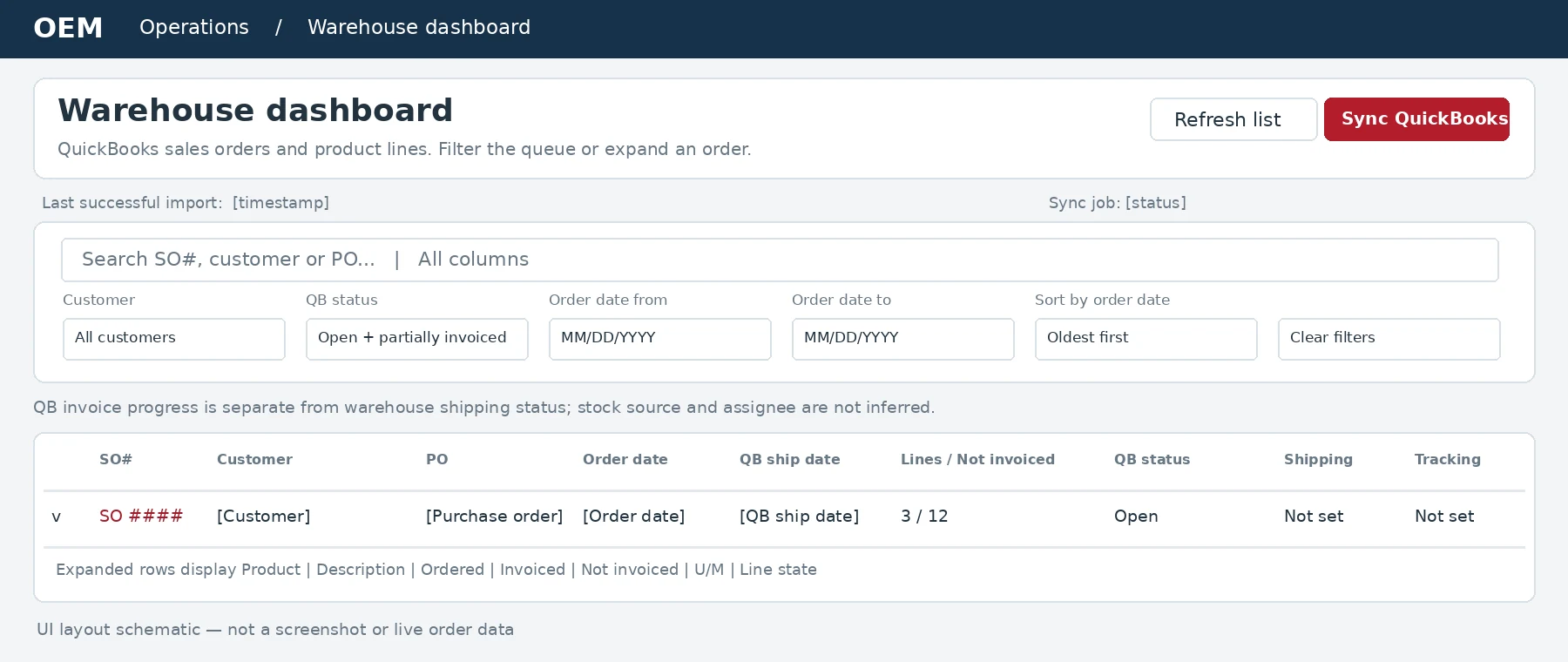
A separate, read-only warehouse dashboard imports QuickBooks Desktop sales orders and displays ordered, invoiced and not-yet-invoiced quantities. It helps staff prioritize follow-up on open orders. It does not confirm shipments or track pick/pack completion, and the imported QuickBooks orders remain distinct from locally created B.O.S.S. orders.
For a distributor operating under ship-and-debit agreements, a profitable quote can depend on collecting an eligible manufacturer credit. Until a credit is received, some cash remains tied up. Knowing which sales qualify for a rebate, submitting the claim on time and reconciling the payment are important financial control opportunities.
Potential next step: Rebate eligibility reporting and automated claim submission are opportunities for further development, not capabilities represented as deployed at OEM. Eaton provides documented electronic rebate mechanisms and related API offerings, subject to access and program requirements.
Winning is in the WIP™. For distributors, understanding the economics of individual orders can help management identify where expected margins or cash recovery are at risk. The same principle applies to manufacturing operations where inventory, labor and other costs are committed before the order is completed.
Related reading: Why distributors lose margin through inconsistent pricing.
ERP alternatives
Some businesses need a new ERP. Others can retain their accounting or enterprise systems and replace spreadsheet-dependent operational processes with integrated software. The distinction becomes particularly important when the business has specialized rules that require significant customization.
Ayoka’s independently available ERP Fit & Operational Architecture Assessment examines the business requirements, current systems, proposed ERP fit, integration options and lifecycle economics. Ayoka can recommend proceeding with an existing vendor, retaining current systems, implementing a different ERP or building a separate operational application, depending on the findings. If custom development is recommended, Ayoka can also offer software through its rental model.
Identify requirements that can be handled by standard configuration, clarify gaps and compare options before committing to implementation expenditures.
Evaluate unresolved requirements, remaining implementation costs, risks and alternatives. Determine whether to continue, revise the approach or stop the project.
Texas distribution businesses
Whether you supply machine builders across North Texas or industrial, energy and process-industry customers around Houston, your ability to quote competitively and deliver reliably matters. Ayoka can evaluate the software you already have, the manufacturer data you need and the business rules that differentiate your operation.
We can work with your existing accounting or ERP system, and where appropriate build specialized software you can rent rather than make a large upfront software investment.
Arlington / Dallas–Fort Worth — Ayoka's headquarters.
Houston custom operational software development — industrial and energy-sector workflows.
Frequently asked questions
Start with the business you want to win
If quoting depends on spreadsheets, manual manufacturer lookups or an expensive ERP customization, tell us where the process is slowing down. We can examine your current workflow and determine what belongs in your accounting system, ERP or specialized operational software.
Ayoka Systems · Arlington, Texas · 100% U.S.-based
Tell us what you’re seeing. We’ll start with the operational problem and help determine what is getting in the way.